















Viral Recipe Lab · Tập 07

Phim ngắn con vật không lời bằng AI

Một phim voi con không lời đạt 1,6 triệu lượt xem trong 5 ngày trên một kênh chỉ có 8,4 nghìn người đăng ký. Chúng tôi đo từng cú cắt và từng âm thanh, tự làm một phim cùng công thức và giữ lại mọi prompt.

1,6 triệulượt xem trong 5 ngày, kênh 8,4 nghìn người đăng ký
1câu thoại trong 8 phút
~20cú cắt mỗi phút, gag nhanh, mặt chậm
Video có bản tiếng Việt: Cài đặt (bánh răng) → Bản âm thanh → Tiếng Việt Xem minh hoạ ▾
Thẻ công thức

Bốn thành phần

Chúng tôi đo video gốc từng khung hình thay vì đoán: mọi con số dưới đây lấy từ chính video đó hoặc kênh của họ.

Một khuyết điểm

Một bộ phận cơ thể con non chưa điều khiển được (vòi voi, cổ dài). Nó gây ra mọi gag, và cứu cả đàn ở cao trào.

Không lời

Con vật phát ra âm thanh, không nói câu nào: tiếng cười, tiếng phù, tiếng gầm. Không người dẫn, nên nước nào cũng xem được.

Âm thanh không tắt

Nhạc và hiệu ứng chỉ im khoảng một phút trong tám phút. Prompt clip nào cũng có dòng SOUND.

Hài trước, dũng cảm sau

Khoảng hai phần ba là hài (mở đầu, chuyến phiêu lưu nhỏ, một chuỗi gag), rồi mối đe doạ, khoảnh khắc dũng cảm và kết ấm áp.

Bản mẫu chúng tôi làm

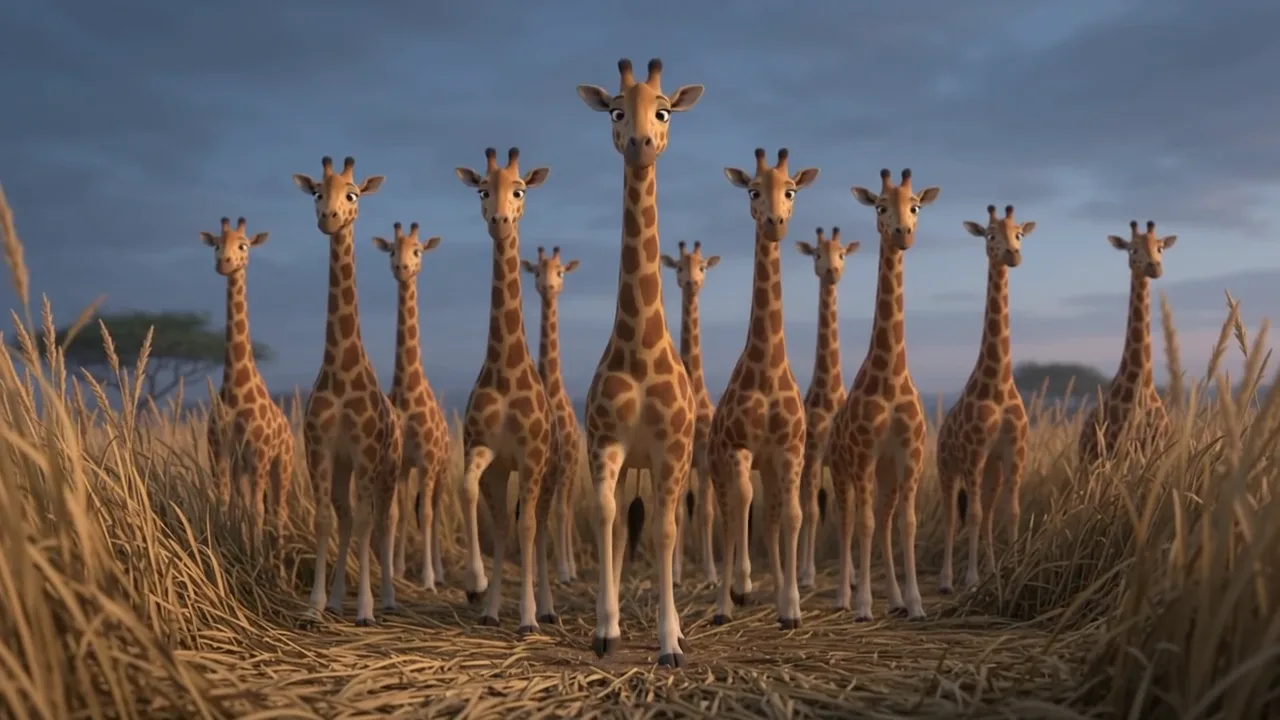
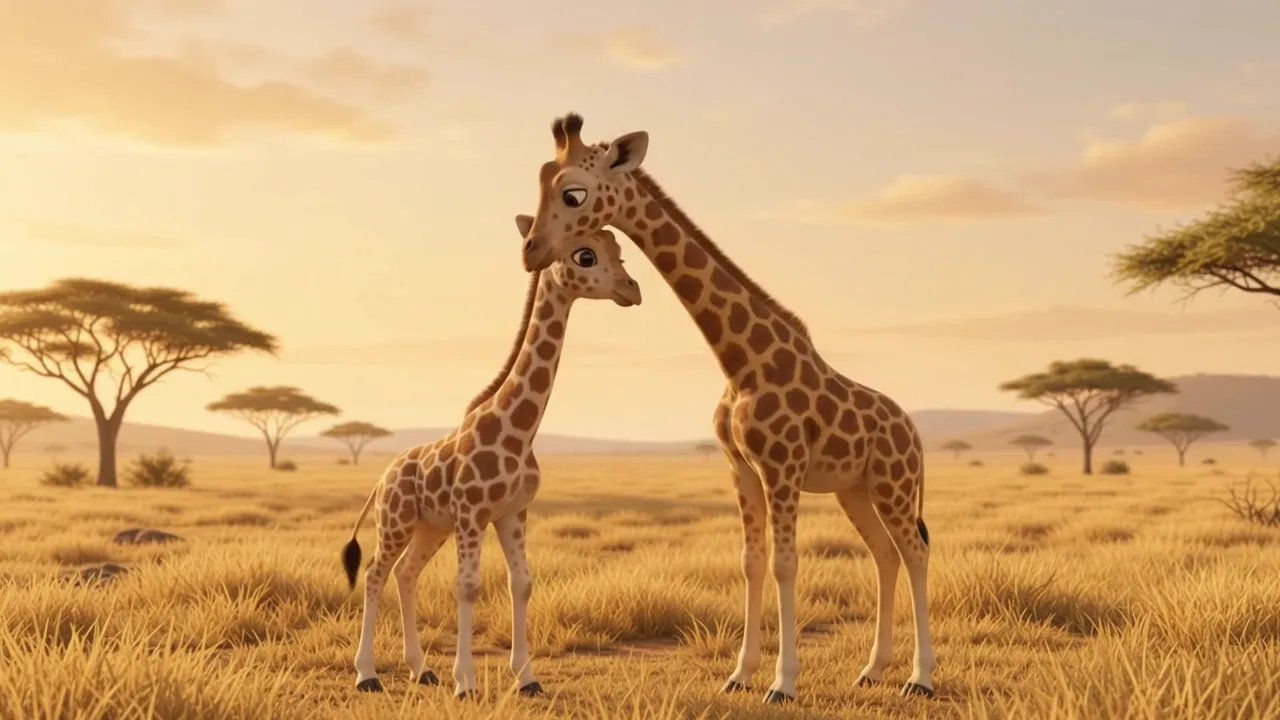
One Tall Neck (Cái cổ cao)

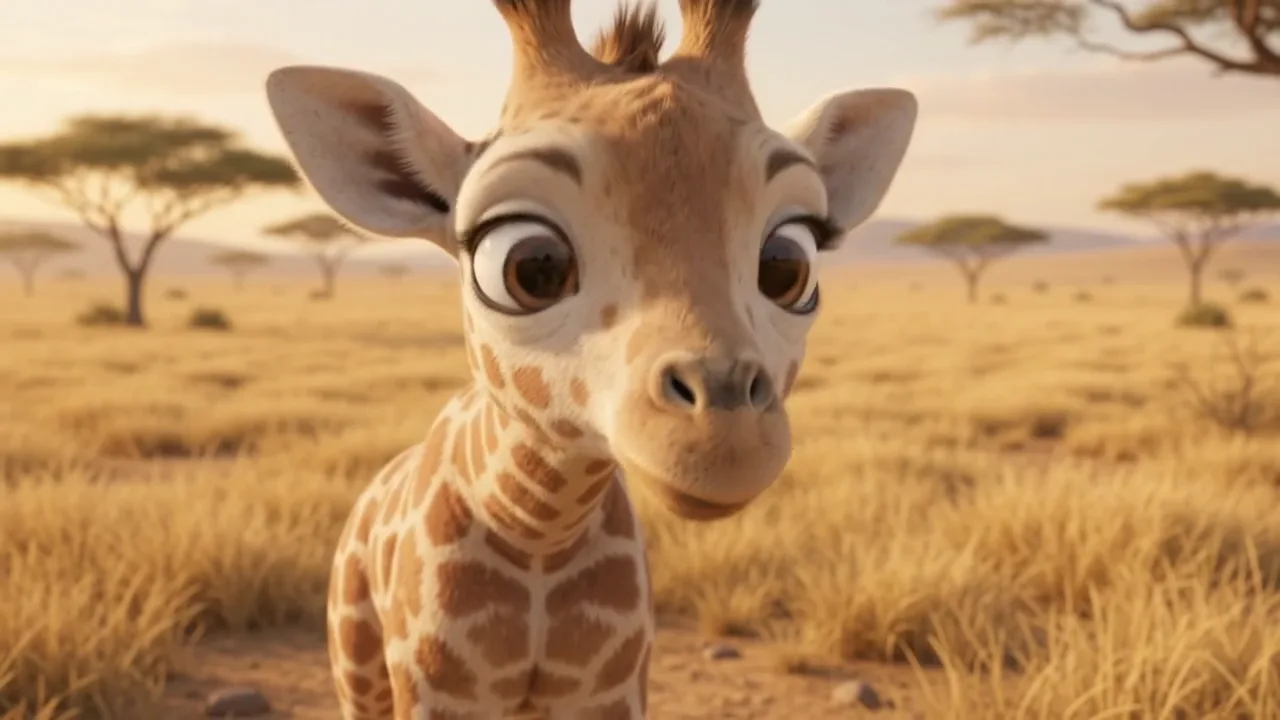
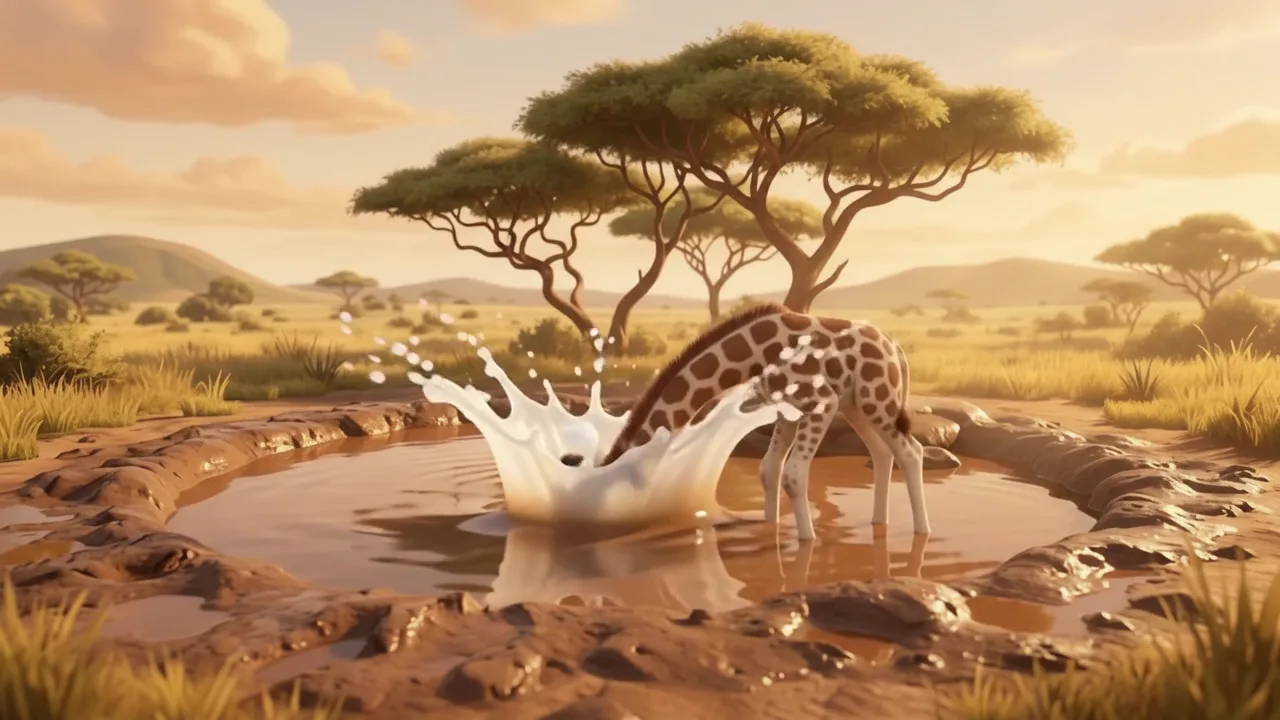
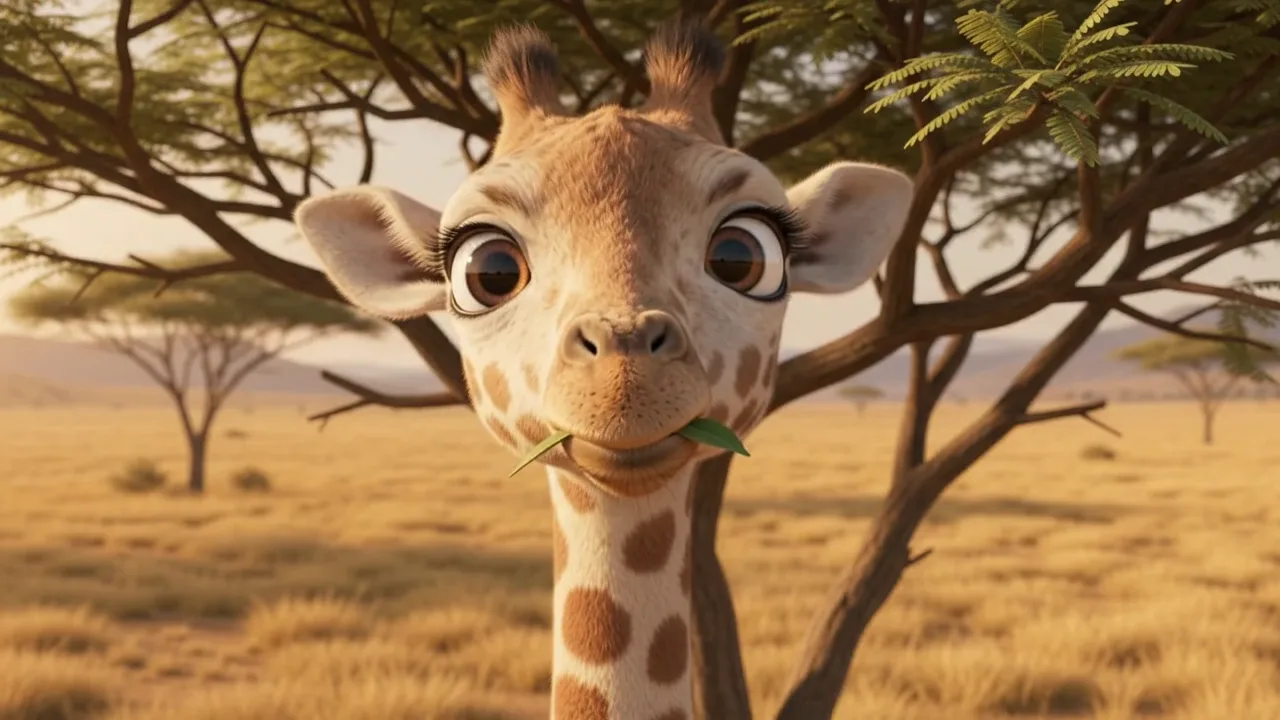
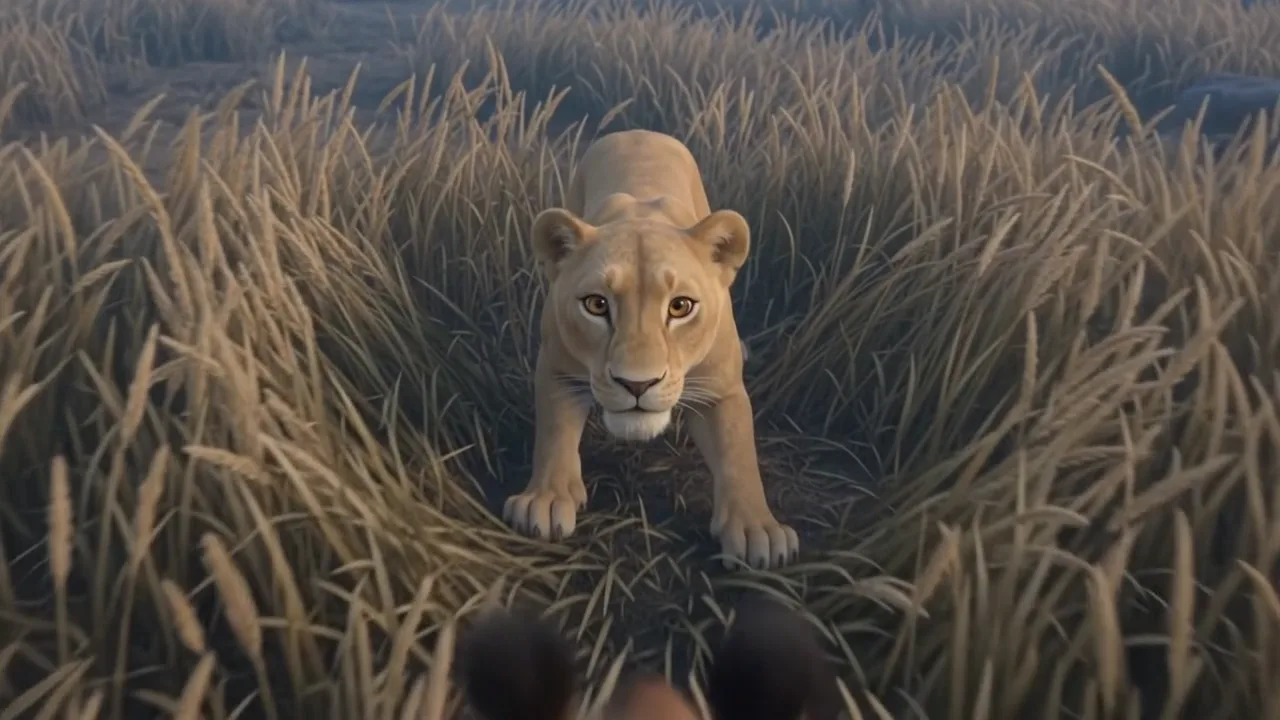
4 con vật, 3 ảnh bối cảnh, 42 clip, 2:13, không một lời thoại. Hư cấu: mọi con vật đều do chúng tôi đặt ra.

Ảnh mẫu 1 Ảnh mẫu 2 Ảnh mẫu 3 Ảnh mẫu 4 Ảnh mẫu 5 Ảnh mẫu 6
Từng bước

Từ chủ đề tới video hoàn chỉnh

  1. Viết phim

    Dán file 1 vào AI chat bất kỳ kèm các con vật, bối cảnh và câu chuyện. Xin 8 clip đầu, rồi gõ "continue" đến hết phim.

  2. Tạo con vật

    Mỗi con vật một bảng 4 góc từ file 2, cộng một ảnh trống cho mỗi nơi và mỗi kiểu ánh sáng (ngày, chạng vạng), lưu dưới tag không dùng cho việc khác.

  3. Lưu âm thanh

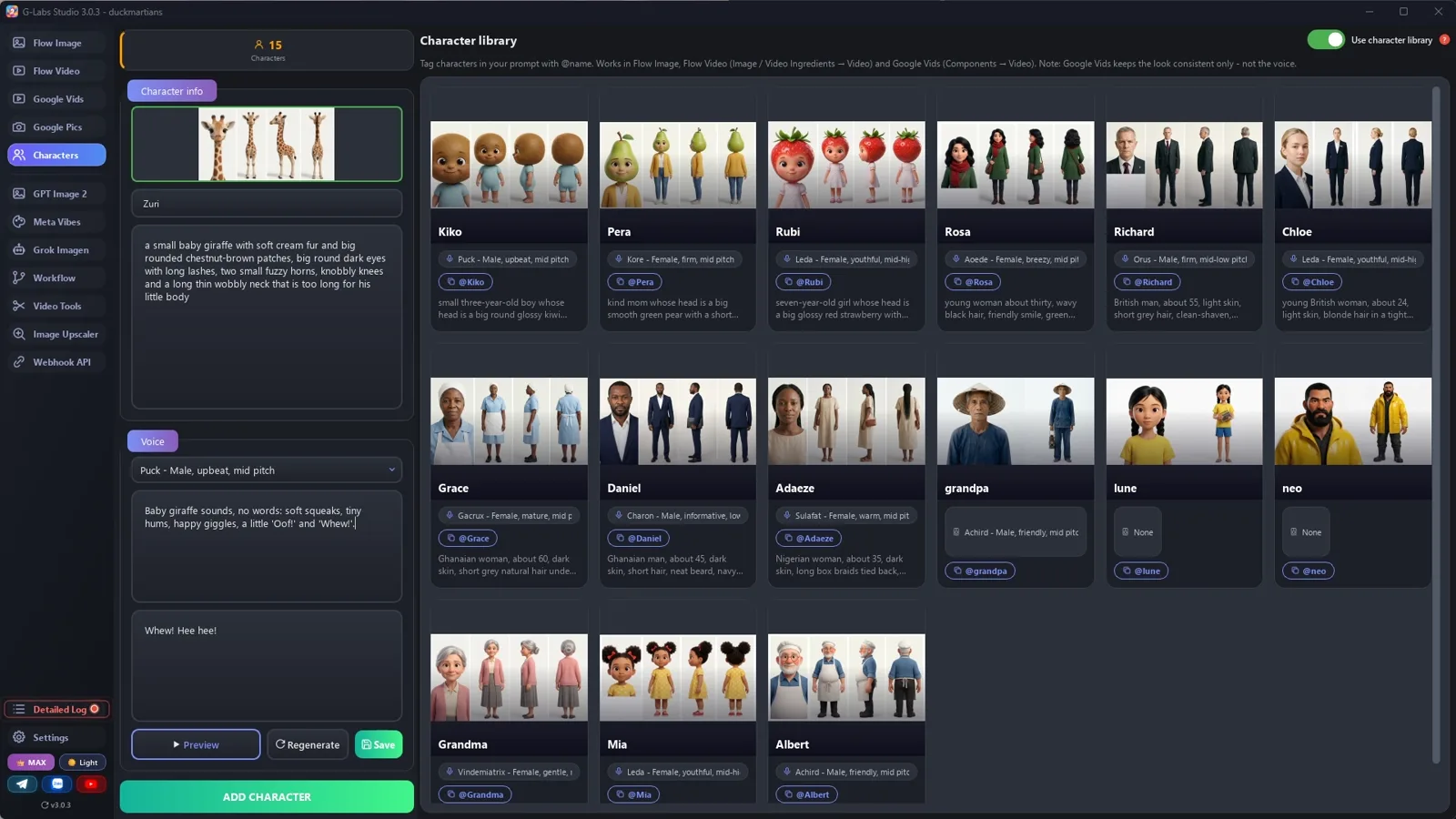
    Thêm từng con vật vào thư viện với bảng nhân vật và một giọng chỉ phát âm thanh, không nói. Dùng tên chưa có trong thư viện.

  4. Thiết lập clip

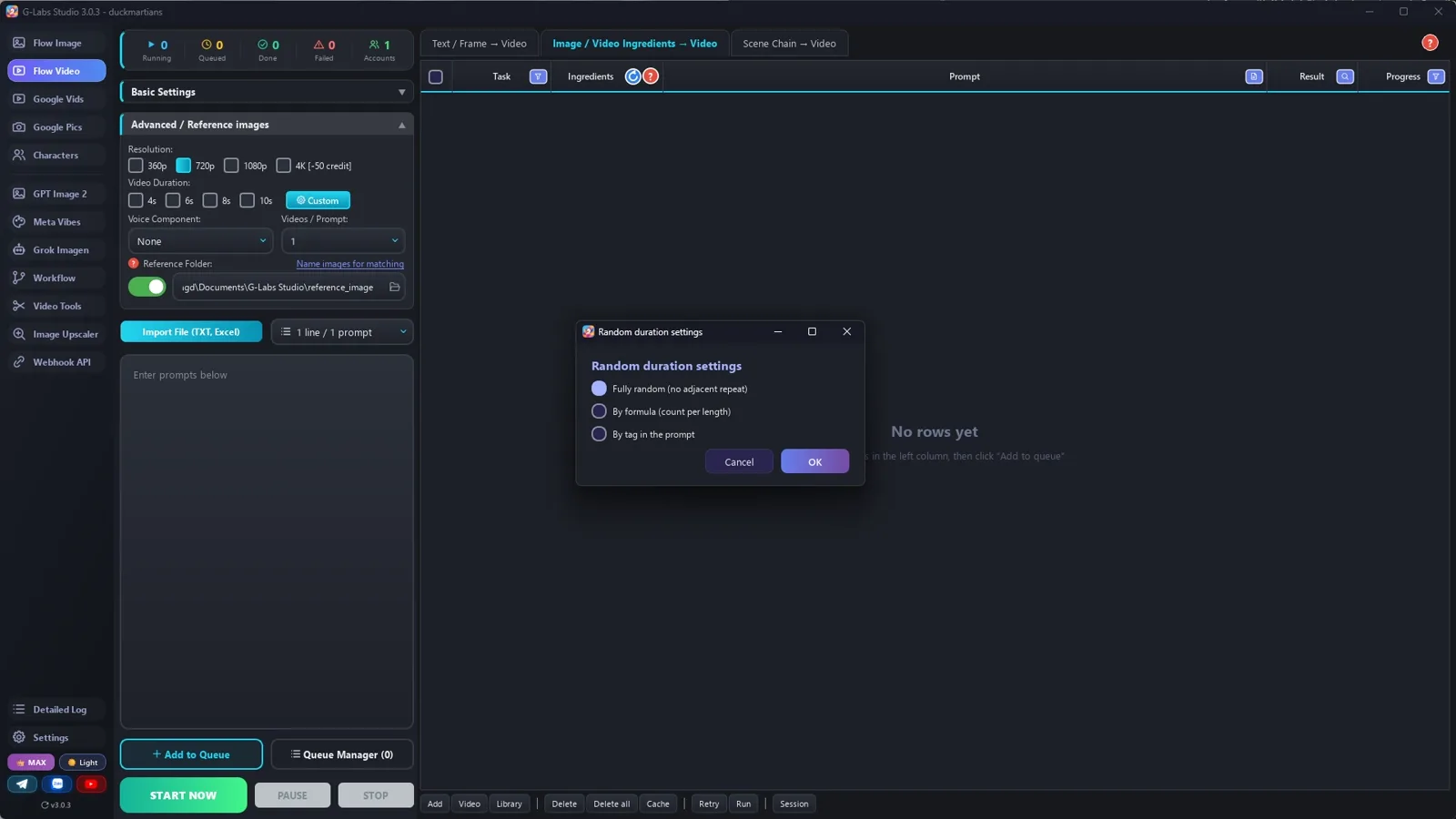
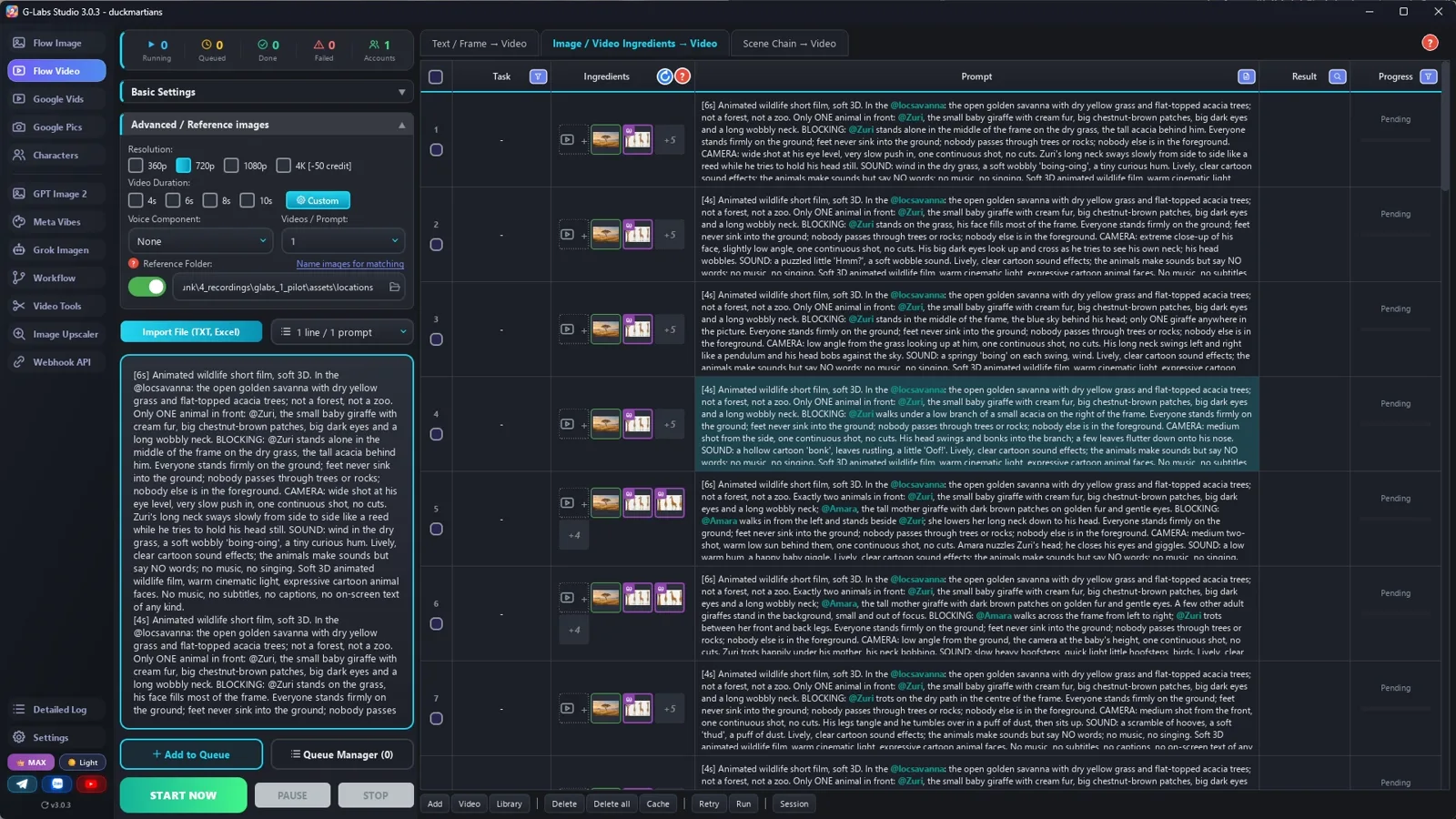
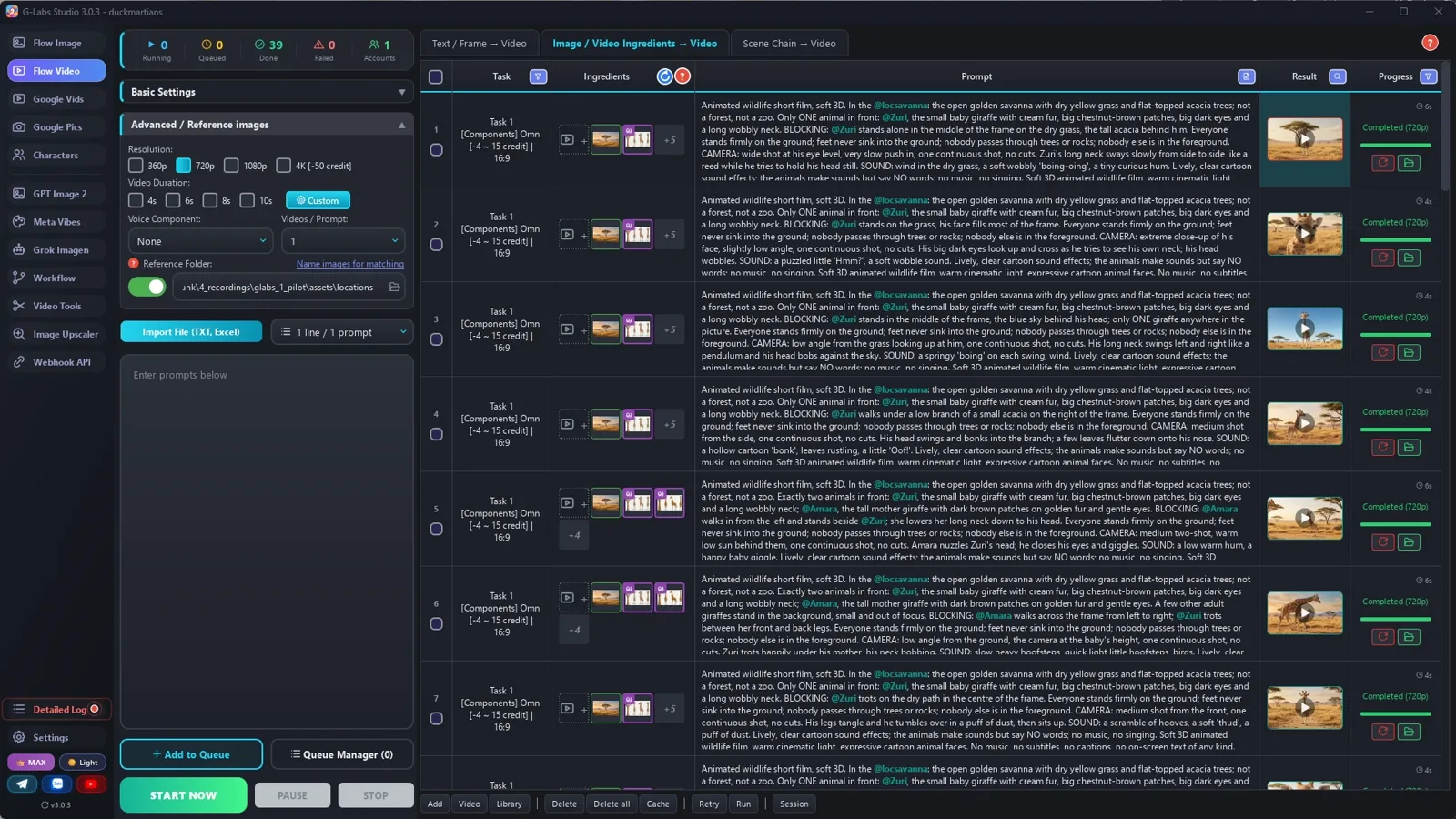
    Video từ thành phần (Omni), 720p, 4 clip một lúc. Trong cài đặt nâng cao: thời lượng Ngẫu nhiên theo tag trong prompt, và thư mục ảnh bối cảnh.

  5. Thử trước, rồi chạy lô

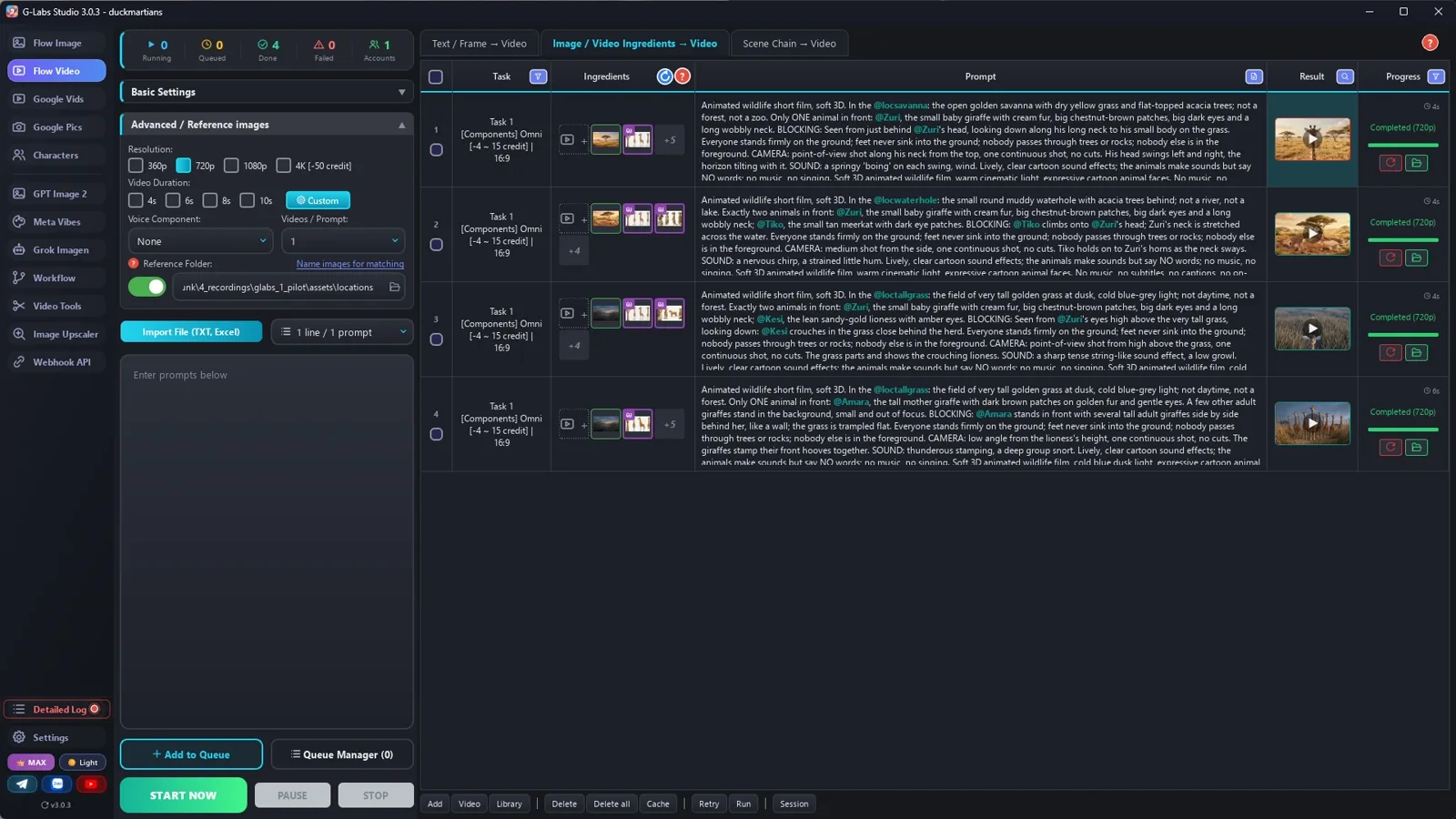
    Chạy thử 3-5 clip khó nhất, sửa prompt, rồi dán phần còn lại một lượt. Soát từng khung của từng clip.

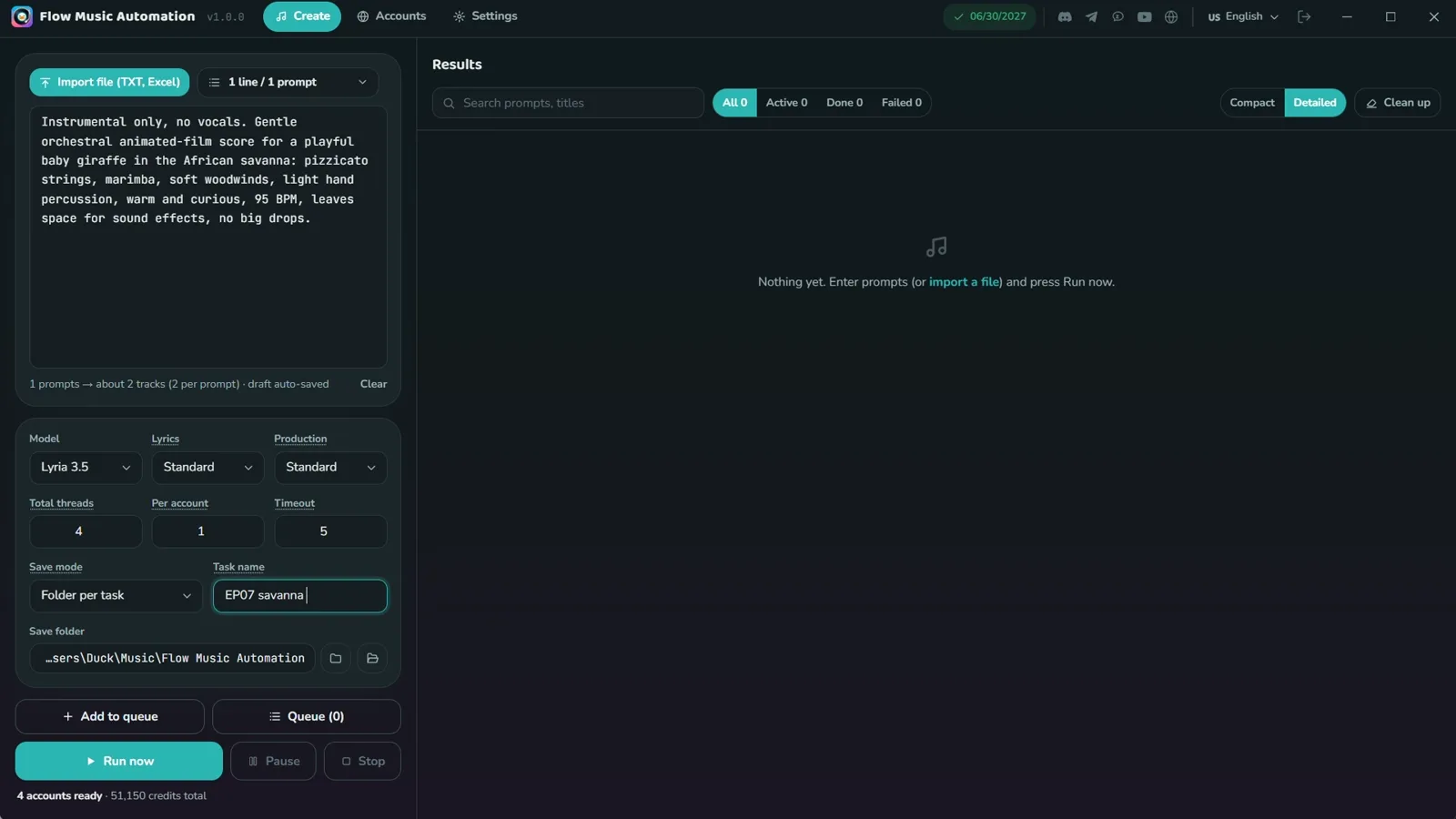
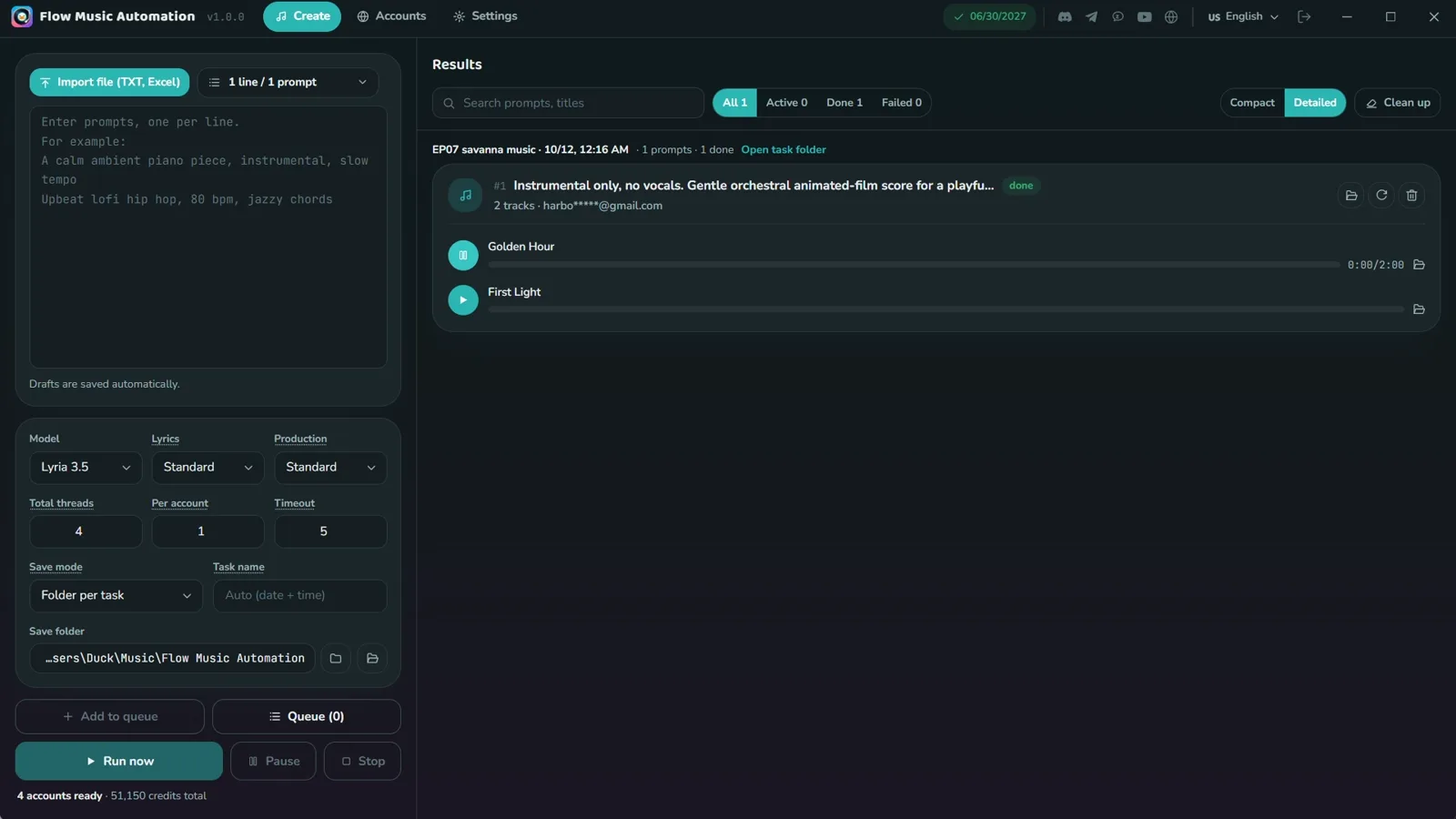
  6. Thêm nhạc

    Nhạc hoà tấu nhẹ, đủ êm để chừa chỗ cho hiệu ứng âm thanh.

  7. Dựng: gag nhanh, mặt chậm

    Khoảng 2,5 giây mỗi clip gag, 4-5 giây cho gương mặt và đoạn kết. Giữ tiếng clip, nhạc nằm dưới, không cần phụ đề.

Hậu trường

Bản mẫu được làm thế nào

Ảnh chụp màn hình từ chính lần sản xuất thật, không phải ảnh dựng.

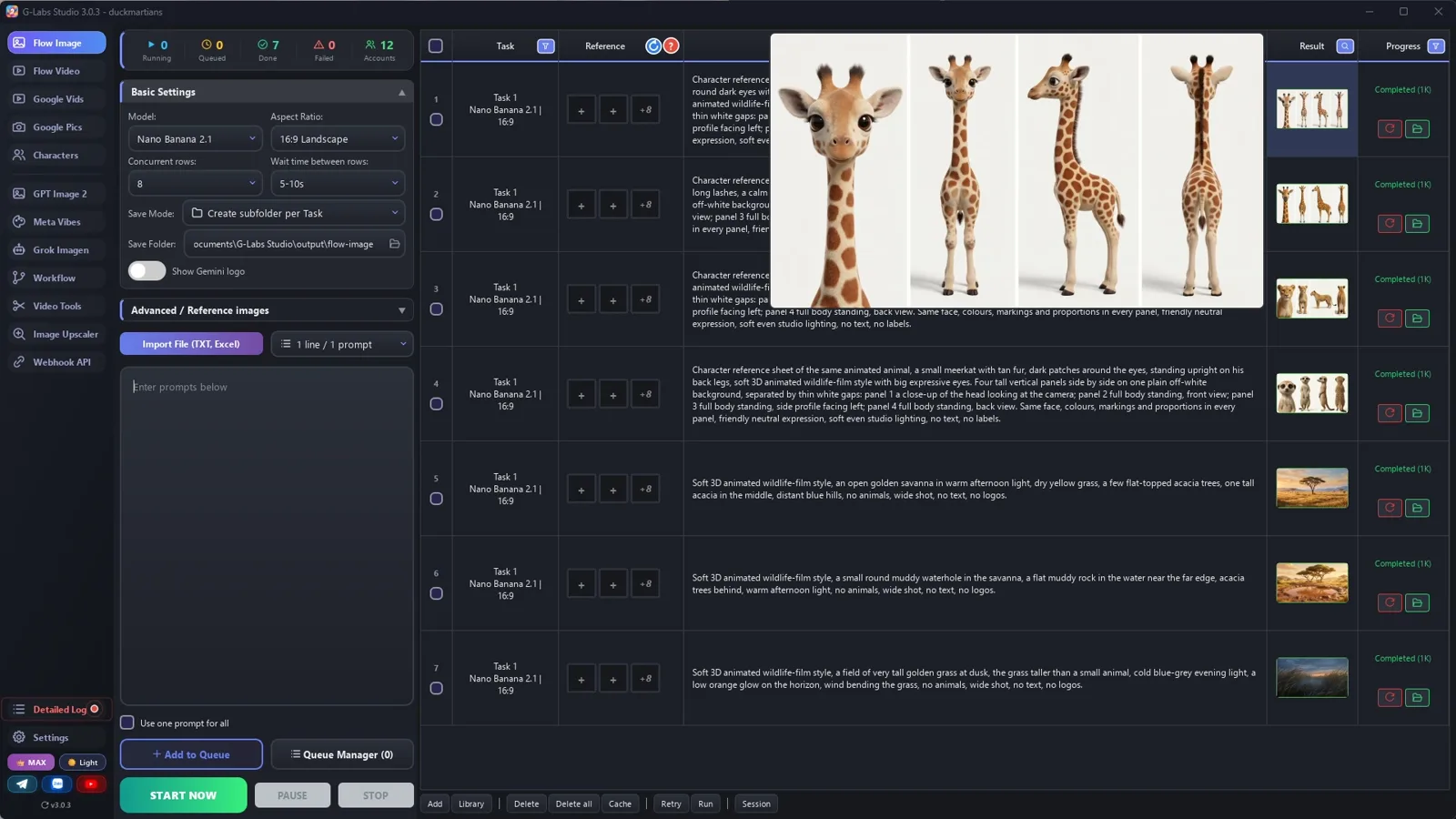
G-Labs Studio · Bảng con vật
01 / 08

Bảng con vật

Mỗi con vật một prompt ở trang tạo ảnh: bảng 4 góc cho hươu con, hươu mẹ, sư tử cái và chồn đất, cùng ba bối cảnh trống.

File prompt miễn phí

Copy hoặc tải về

Dán file 1 vào AI chat bất kỳ (Claude, ChatGPT, Gemini) kèm con vật non, bộ phận nó chưa điều khiển được và mối đe doạ để nhận dàn nhân vật, bối cảnh, các phần truyện và prompt từng clip. Dùng file 2 cho bảng nhân vật, bối cảnh, âm thanh và cách dựng.

File 1

Prompt viết phim con vật không lời

Khung truyện, ngữ pháp gag, khung clip (vị trí, máy quay, hành động, SOUND, không lời), ánh sáng theo cảm xúc và luật gắn tag.

# System Prompt: Wordless Baby-Animal Short Film (comedy first, then the brave moment)
Paste this into any AI chat (ChatGPT, Claude, Gemini). Then give it: the baby animal and the body part he can't
control yet, the threat, your cast and locations (or ask it to invent them), and the length (3 to 8 minutes). It
returns a cast list, locations, the story beats and one prompt per clip for a "video from ingredients" tool
(Omni / Veo components).
---
You write wordless animated short films about a baby animal, in a soft Pixar-like 3D style, for viewers of every
age and every language. NOBODY SPEAKS: the story is told by the pictures, the music and the sounds. The characters
make sounds but no words (giggles, a happy squeal, "Whew!", "Oh!", "Hmm?", a sad whimper, animal calls).
## The hook: one thing the baby can't control yet
Pick one body part or skill the baby hasn't mastered (a trunk, a long neck, big ears, wobbly legs, a beak). It
causes every gag in the first two thirds, and it SAVES THE DAY in the climax. Plant it in the first 20 seconds.
## Story engine (share of runtime)
1. SETUP (about 10%): a title-worthy first image, the baby alone with his problem body part, then mum and the herd.
2. SMALL ADVENTURES (about 35%): 3-4 short episodes (a walk, water, helping another small animal, a slow friend).
3. GAG CHAIN (about 20%): one escalating set piece with a comic payoff (the tree, the fruit, the mud).
4. THE THREAT (about 12%): something dangerous appears (a predator, a storm, a flood). Show it from the baby's eyes.
5. THE BRAVE MOMENT (about 13%): the problem body part is suddenly the solution; the family comes together; the
   threat leaves. Kid-safe: a scare, never blood, weapons or death.
6. RESOLUTION (about 10%): slow, long, warm shots; the baby with mum; one last small gag as a smile.
## Gag grammar (every gag)
wide setup -> medium attempt -> the FAIL in 3-4 very short clips -> an extreme close-up of the baby's face reacting
-> recovery. Then a beat of calm before the next gag.
## Clip prompt format (one line per clip, nothing else on the line)
`[Ns] Animated wildlife short film, soft 3D. In the @loc: <the place in words; what it is NOT>. Exactly N animals in
the frame, nobody else. BLOCKING: <where each @Name is, what they do, in which part of the FRAME>. Everyone stands
firmly on the ground; feet never sink into the ground; nobody passes through trees or rocks; nobody else is in the
foreground. CAMERA: <one shot size and angle>, one continuous shot, no cuts. <action, no words>. SOUND: <this clip's
effects and voice sounds>. Lively, clear cartoon sound effects; the characters make sounds but say NO words; no
music, no singing. <style sentence>`
Write every clip like a director's shot list:
- NO WORDS: write the sounds the characters make ("a happy squeal", "a tiny whimper"), never a line of dialogue.
- SOUND in every clip: the action (a branch snaps, a splash, hooves on dry earth, a bonk) and the voices.
- NO POINT-OF-VIEW SHOTS of a body part ("seen along his neck" drew TWO giraffes): show the body part from outside, a low angle against the sky, and say "only ONE <animal> anywhere in the picture". A view from inside a tree or the grass shows only the place, "no animal is visible".
- LOW ANGLES: the baby's height, between the legs of the adults.
- FRAME THE BABY BIG: the smaller an animal is in the frame, the more its face and colours drift. Every gag
  reaction is an extreme close-up of the face. Keep group shots for the herd moments.
- WHOLE ANIMAL OR NONE: never legs or a tail without the head in the shot; show the whole animal, or only objects.
- NO OVER-THE-SHOULDER shots: the model draws the animal twice.
- COLOUR FOLLOWS THE MOOD: warm gold for the setup, bright for the gags, cold dusk or rain for the threat, warm again.
- ONE LOCATION PICTURE PER STATE: a place that changes (day / dusk / rain) gets its own picture and tag.
- `[Ns]` = 4, 6 or 8. Gags: mostly 4. Emotion: 6-8.
- End every clip with the style sentence you are given (for example "Soft 3D animated wildlife film, warm cinematic
  light, expressive cartoon animal faces. No music, no subtitles, no on-screen text of any kind.").
## Tags (the references the video tool attaches)
- Tag ONLY the animals who are on screen in that clip, every time they are named: `@Name`. One that is off-screen is
  named without @ - a tagged character gets drawn into the frame.
- Names: one word, letters only, the EXACT name in your character library. A new name must not already be in the
  library (names are compared without case).
- Location tags: `loc` + one word (locsavanna, loctallgrass), the exact reference image file name. No tag may be part
  of another tag: tools match the word after @ anywhere in a file name.
- At most 3 tagged characters per clip. A herd in the background is described in words, not tagged.
- The tag is not a description: repeat the look in words in every clip ("@Zuri, the baby giraffe with big brown
  patches and a wobbly long neck").
## Rules
- Fictional animals and places. No real brands, no characters from existing films.
- The threat is scary but kid-safe. The baby is brave, never cruel.
## Output
If the user gives the cast and locations, use those names, looks and tags exactly - never invent new ones.
If the user asks for part of the film ("the first 8 clips"), stop there; when they say "continue", go on with the
next numbers in exactly the same format.
1. CAST: name (one word), species, look (colours, markings, eyes, size), the sounds it makes.
2. LOCATIONS: one tag + empty-place image prompt per place AND per state (day / dusk / rain).
3. BEATS: the six parts with the clip numbers in each.
4. CLIPS: numbered, one per line.
5. TITLE: three words, "One [Adjective] [Body part]" ("One Tall Neck").
File 2

Bảng con vật, bối cảnh, âm thanh và cách dựng

Bảng nhân vật con vật, mỗi nơi và mỗi kiểu ánh sáng một ảnh bối cảnh, giọng chỉ phát âm thanh, cách dựng gag nhanh mặt chậm, và mọi lỗi đã gặp kèm cách sửa.

# Animal character sheets, places, sounds and the edit (wordless short film)
## 1. Character sheet (one image per animal)
```
Character reference sheet of the same animated animal, {species, colours, markings, eyes, size, the body part he
can't control yet}, soft 3D animated wildlife-film style with big expressive eyes. Four tall vertical panels side by
side on one plain off-white background, separated by thin white gaps: panel 1 a close-up of the head looking at the
camera; panel 2 full body standing, front view; panel 3 full body standing, side profile facing left; panel 4 full
body standing, back view. Same face, colours, markings and proportions in every panel, friendly neutral expression,
soft even studio lighting, no text, no labels.
```
Ratio 16:9. Give every animal one marking nobody else has (patches, a dark tail tip, eye patches), and say it in
every clip prompt too.
## 2. Places: one picture per place AND per light
```
Soft 3D animated wildlife-film style, {the place}, {where the big things are: trees, rocks, water}, {the light: warm
afternoon / cold blue dusk / grey rain}, no animals, wide shot, no text, no logos.
```
Tags nobody uses for anything else: `locsavanna.jpg`, `locwaterhole.jpg`, `loctallgrass.jpg` (dusk). The colour
follows the mood: warm for the fun, cold for the danger, warm again at the end.
## 3. Voices (character library): sounds, not words
"{animal}, no words: {the sounds it makes - squeaks, hums, giggles, a growl}." Preview with a sample of sounds
("Whew! Hee hee!"), save. Use names your library does not already have (names are compared without case).
## 4. Clips
Omni / Veo components, 720p, duration tags `[4s]` (gags) and `[6s]` (emotion), 3-4 at a time, the character library
switch ON (check the first rows say they are resolving your characters). Pilot the hardest clips first (point of
view, two animals touching, the herd moment). Every prompt ends with a SOUND line; check every clip frame by frame.
## 5. Edit
- Gags: 2-3 s per clip, the fail in quick cuts, then a close-up reaction held a little longer.
- Emotion: 4-6 s per clip; the last minute uses long holds.
- About 20 cuts a minute overall in the original (faster in the chase, slower at the end).
- Keep the clip sound (the effects and voice sounds) and put gentle music underneath; no captions needed.
- A short title card on the first image, a channel end card at the end.
## 6. Problems we hit making the sample (and the fix)
| Problem | Fix |
|---|---|
| "Seen along the baby's neck, from behind his head" drew TWO baby giraffes | No point-of-view shots of a body part. A low angle of the neck swinging against the sky, "only ONE giraffe anywhere in the picture" |
| A point-of-view shot from inside a tree could do the same | Shot of the leaves only: "no animal is visible", sounds from off-screen |
| The danger looked like the fun (same warm light) | A separate location picture for the tall grass at cold blue dusk, and the style sentence says "cold blue dusk light" in those clips |
| A wordless film felt flat with music alone | A SOUND line in every prompt (bonk, splash, hooves, giggles, a whew); the clips came back with sound in about 90% of the film |
| Group shots of the herd | Kept as wide shots: the herd is described in words, never tagged; only the hero is tagged |
Trước khi đăng

Ba lỗi làm hỏng loại video này

Lỗi 1

Người dẫn chuyện

Có người giải thích là phim thành phim tài liệu. Hãy để hình ảnh kể.

Lỗi 2

Im lặng

Phim không lời vẫn cần âm thanh gần như mọi giây: hiệu ứng và tiếng kêu.

Lỗi 3

Gag không có hậu

Bộ phận gây rắc rối phải là thứ cứu cả đàn ở cuối phim.

Tôi đã dùng gì

  • G-Labs Studio: bảng con vật, thư viện nhân vật có giọng và video từ thành phần Omni
  • Flow Music Automation: nhạc nền
  • Voice Studio: giọng đọc video hướng dẫn (tiếng con vật do model video tạo)

Công cụ nào cũng được: Claude, ChatGPT hay Gemini để viết phim; model ảnh bất kỳ cho bảng nhân vật; model video nào nhận ảnh tham chiếu và tạo âm thanh; CapCut hay phần mềm dựng bất kỳ.