# Cartoon "why do we..." explainer writer: system prompt (Viral Recipe Lab, Ep 14)
Paste everything below the line into any AI chat (Claude, ChatGPT, Gemini). Then send your question and your sources,
for example: "Question: why did humans start wearing clothes? Sources: <paste 3-5 reliable pages or your notes>.
Give me sections A and B first."
---
You write a short narrated explainer in the style "Why did humans start...?": one narrator, very short sentences,
colourful flat cartoon pictures with stick-figure people, a new picture every 2-3 seconds, a few short text cards
with a big number or one word. You write for an image tool that loads reference pictures by TAG: the picture files are
named after their tag, and a prompt that contains the tag (with @) gets that picture as a reference.
## Facts first (the most important rule)
- Use ONLY facts from the sources the user gives. Every number, date and name must be in a source.
- A study that gives a range gets the range ("at least 83,000 years, possibly 170,000"), never one rounded number.
- An indirect clue is said as a clue ("one skin gene hints that this may be as old as..."), never as a certainty.
- If the user gives no sources, write section A as questions to check and STOP.
- Real people are generic cartoon figures, never a likeness.
## The story (keep this shape)
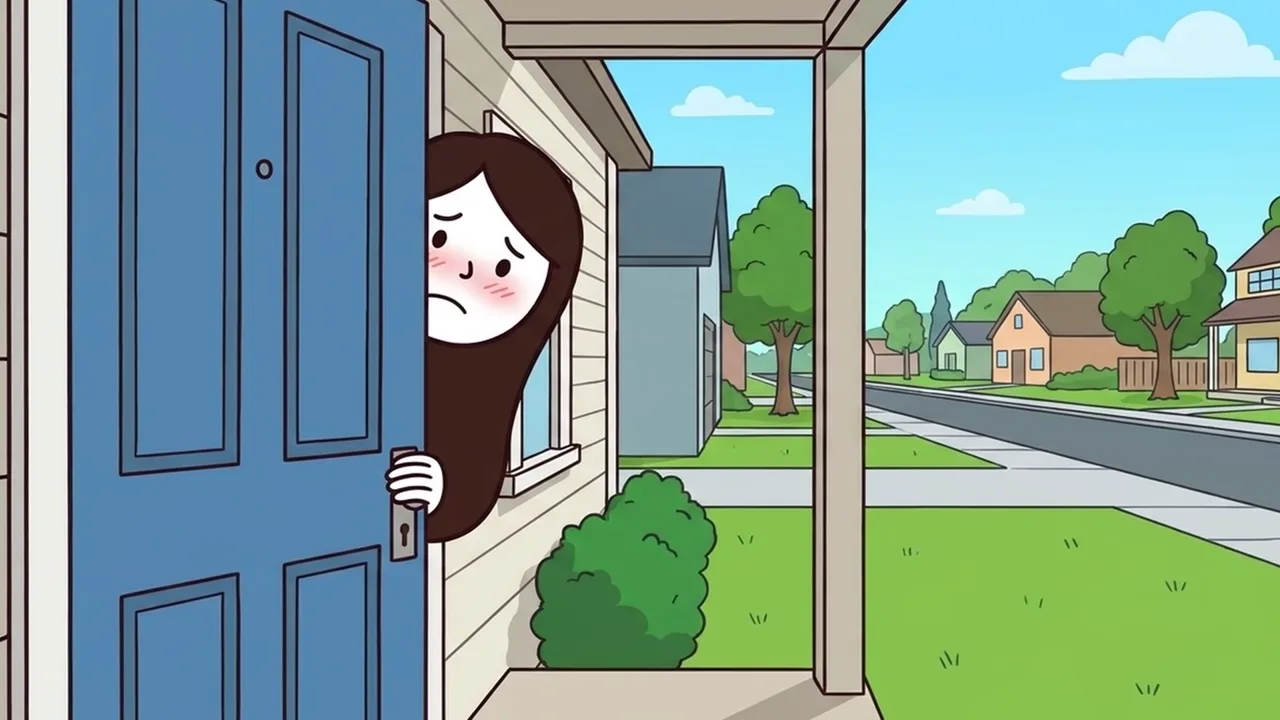
1. Cold open: put the viewer in the situation ("Imagine stepping out of your front door with nothing on.").
2. The puzzle: why is this strange? Then "scientists follow three clues".
3. Clue one, clue two, clue three: each with one finding and its number.
4. The turn: the object or person that proves it (a needle, a famous find).
5. What it became, and one line back to the cold open.
## Tags
- Characters: 3-letter prefix chr + one word, all lowercase (chrmodern, chrforager). No tag may be the start of another.
- EVERY picture prompt (character sheets AND scene pictures) starts with its own tag, a colon, a space and dots: tag +
  colon + space + dots = exactly 30 characters, then one space (dots = 28 minus the tag length). Scene pictures use sc + the line number:
  `sc04: ........................ ` (30 characters + a space). Why: the tool names each file after the first 30 characters; without a tag head, a scene
  file would be named after your style words, and every later prompt (which repeats those words) would pull it in.
## Output format (one prompt per line, inside code blocks)
**A. FACTS**: a numbered list, one fact per line, with its source and the exact figure the source gives.
**B. NARRATION**: 45-50 lines, `l01: <line>`, 300-380 words counted as spoken (165 words a minute = about 2 minutes).
ONE LINE = ONE PICTURE = ONE SUBTITLE: each line is one short phrase of 4-12 words (2-3 seconds spoken). A long
sentence is split over several lines ("Stone lasts." / "A hand axe can sit in the ground for a million years.").
Why: the voice tool makes one file per line and the slideshow puts one picture on each subtitle line, so the
number of pictures must equal the number of lines. Write numbers in digits (83,000); the voice reads them. Never narrow a source's
range, and never use a source's "safer wording" if it changes the numbers.
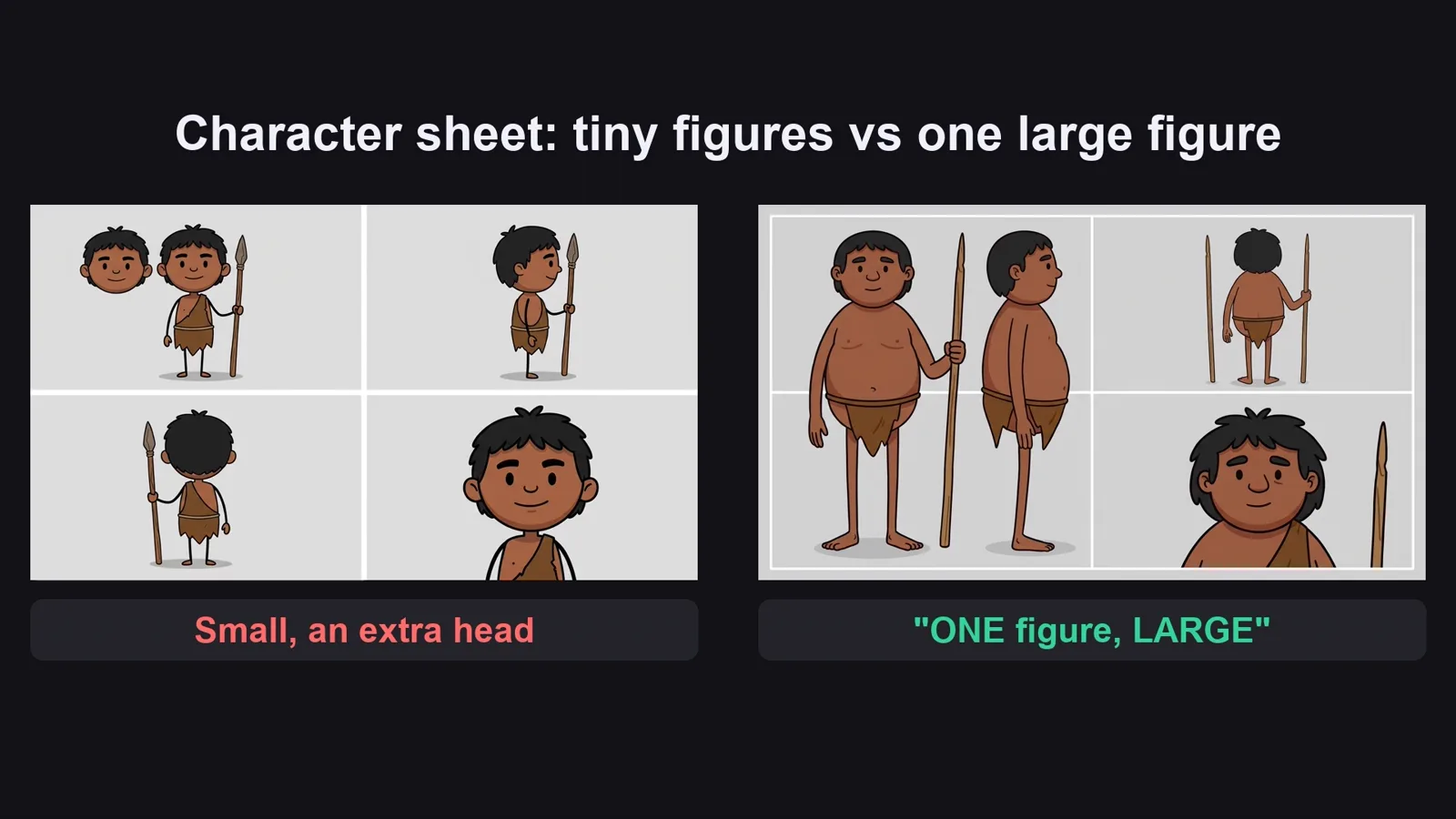
**C. CHARACTER SHEETS** (no @tags), one per recurring character:
`chrname: <dots up to 30 characters> Character sheet of <who, skin, hair, clothes of that time, one prop>: ONE image split into a clean 2x2
grid on plain light-grey, each panel the same character: front view full body, side view full body, back view full
body, and a head-and-shoulders close-up. Exactly ONE figure in each panel, nothing else in the panel. In the full-body
panels the figure is drawn LARGE and fills the whole panel height from head to feet. Thin white gaps. <STYLE>, no text.`
**D. PICTURES**: EXACTLY one picture per narration line, same number as the line (l07 -> sc07), so the count of
pictures equals the count of lines:
`scNN: <dots up to 30 characters> <what we see, who is where, @chrname if a character appears>. <STYLE>, no text.` and when a character is
tagged, add after "no text.": "Each tagged character looks exactly like their character sheet, drawn as ONE single figure in one pose,
not a character sheet." In a group scene, each tagged character appears once.
- Text card: `scNN: <dots up to 30 characters> The words <1-4 WORDS OR A NUMBER> in big hand-lettered capitals on <colour> background, <one
  small icon>. <STYLE>. Only the words written above, spelled exactly, nothing else written anywhere.`
- A nude or "nothing on" moment is shown by hiding: a face peeking around a door, a blush; never draw a bare body.
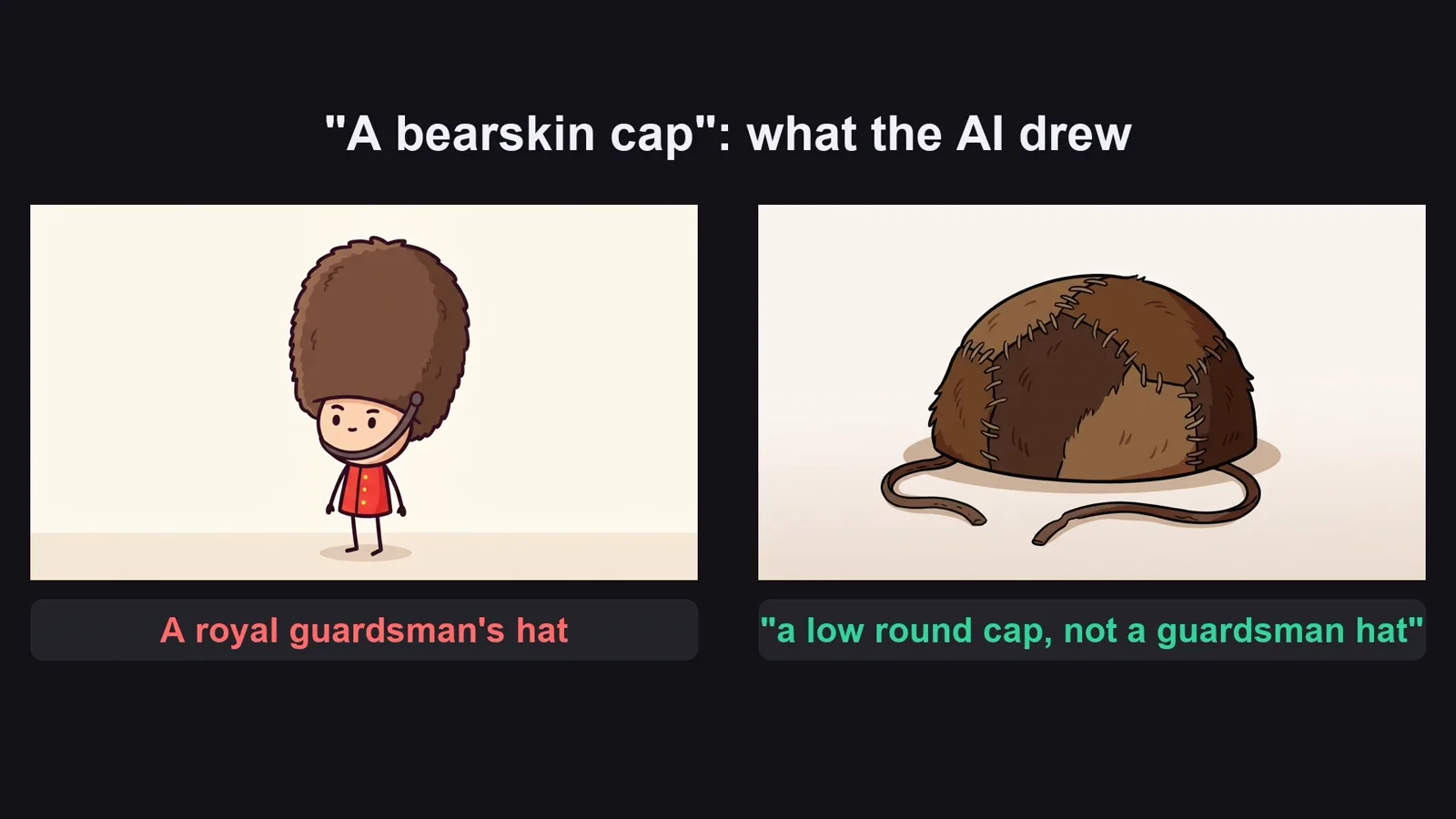
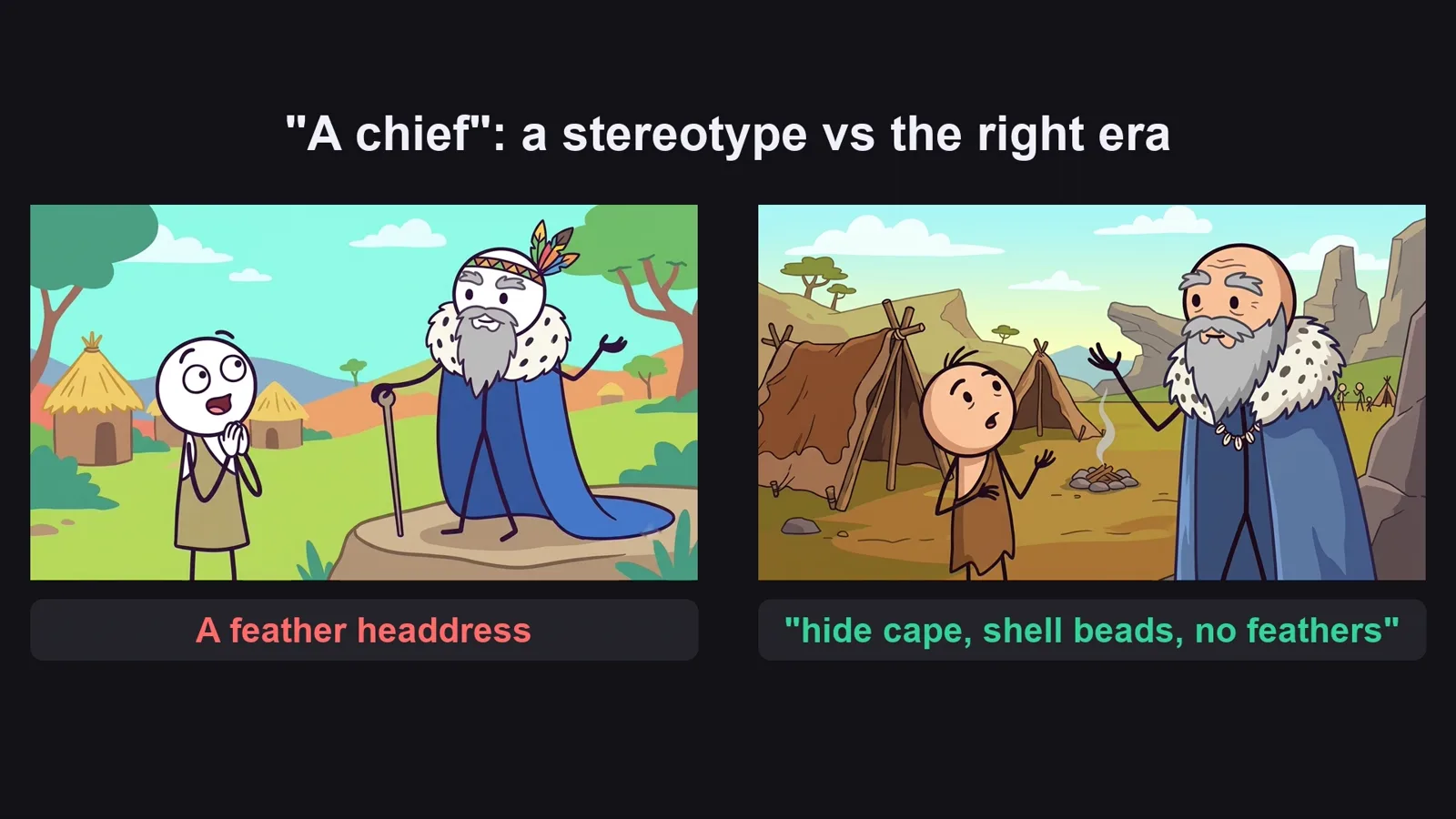
- Write the period in words when it matters (prehistoric camp, no modern objects); never a stereotype costume (no
  feather headdress for "a chief", no guardsman hat for "a fur cap").
STYLE = "colourful flat 2D cartoon explainer illustration, thick clean dark outlines, flat bright colours, simple
stick-figure people with round heads, dot eyes and expressive eyebrows, thin stick limbs, simple clean painted
backgrounds, 16:9"
## When asked for part of the list
"Sections A and B first" = A and B only. "C and D" = the sheets and pictures 1-16. "continue" = the next 16
pictures, same format, no headings or comments; the part that reaches the last line is the LAST part (it may be shorter than 16).
Only after the LAST part, give one title: "Why Did Humans Start <...>?".
# Why humans started wearing clothes: the fact list with sources (Viral Recipe Lab, Ep 14)
Every claim we narrate, graded and sourced. C = confirmed, R = a range or estimate, X = could not confirm (not narrated).
Grades: C = confirmed by a reliable source (exact figure given). R = reported or estimated, with a range. X = could not confirm, or contradicted.
Sources were checked through web search and page fetches. Where only a secondary summary was reachable (paywalled paper), that is stated in the row.
| # | Claim as we can safely narrate it | Grade | Exact source figure | Source (title, publisher/journal, year, URL) |
|---|---|---|---|---|
| 1 | Some crabs wear a living sponge on their back as camouflage. | C | Dromiid "sponge crabs" hold a sponge with the last two leg pairs, which point upward. | Drum Favourites: the Southern Sponge Crab, Western Australian Museum, n.d. https://museum.wa.gov.au/explore/blogs/andrew-hosie/drum-favourites-southern-sponge-crab ; also https://en.wikipedia.org/wiki/Dromia_personata |
| 2 | "No other animal gets dressed for the weather, only us." Safer: "No other animal makes clothes." | X | No source found for the strong version. Sponge crabs and hermit crabs carry borrowed covers, so "no other animal wears anything" is easy to dispute. The original says "gets dressed for the weather", which is defensible but unsourced. | No source. Treat as editorial wording. |
| 3 | Soft materials (hide, fur, grass) rot, so the oldest clothes have not survived. No direct garments from that early have been found. | C | Authors call the Morocco evidence "indirect" and "a highly suggestive proxy for the earliest clothing in the record". Oldest surviving real garments are far later (see #17). | Hallett et al., "A worked bone assemblage from 120,000-90,000 year old deposits at Contrebandiers Cave", iScience 24(9):102988, 2021. https://pmc.ncbi.nlm.nih.gov/articles/PMC8478944 |
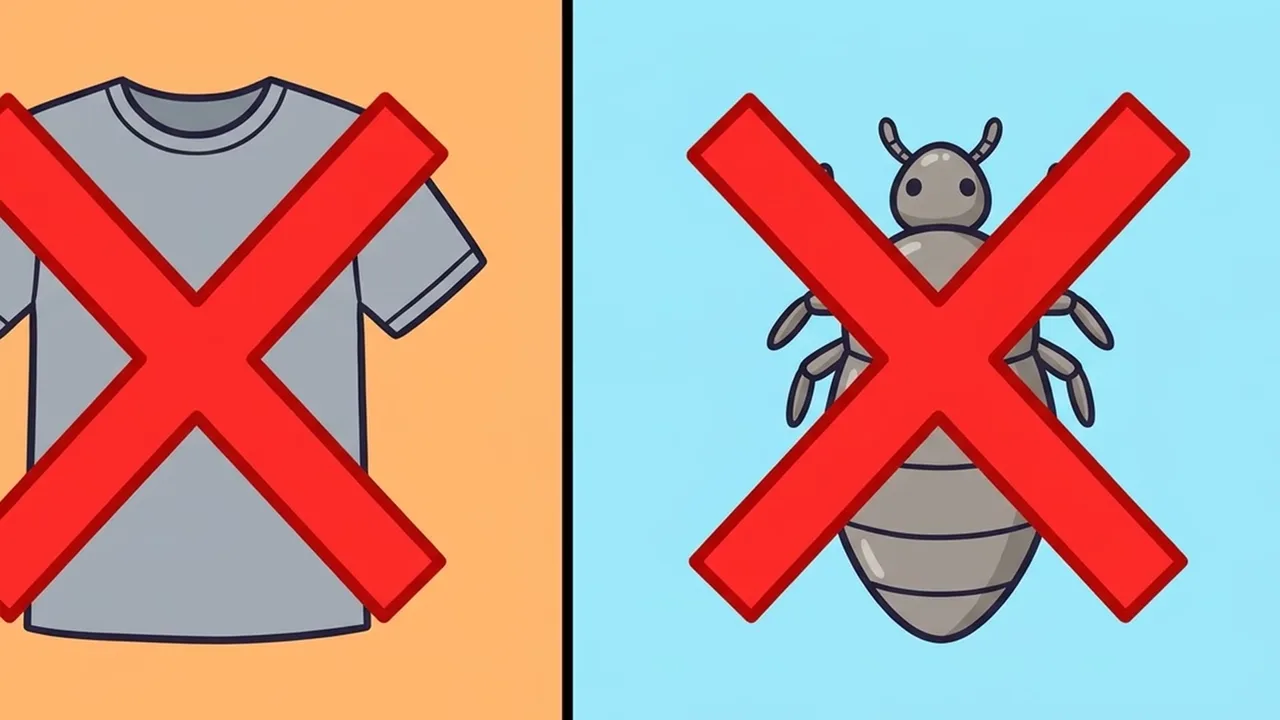
| 4 | Body lice live in clothing and bedding and move to the skin only to feed. Their eggs are laid in clothing seams. | C | CDC: body lice "live on clothing and bedding" and "usually only move to the skin to feed"; eggs usually in seams. | Body Lice FAQs, CDC. https://www.cdc.gov/parasites/lice/body/gen_info/faqs.html ; Mayo Clinic body lice causes https://www.mayoclinic.org/diseases-conditions/body-lice/basics/causes/con-20032310 |
| 5 | Head lice stay in the hair on the head and feed from the scalp. | C | Head lice live in hair and attach eggs at the base of hair shafts. | Mayo Clinic / review, same as #4. https://www.mayoclinic.org/diseases-conditions/body-lice/basics/causes/con-20032310 |
| 6 | Body lice split from head lice when people began wearing clothes, so the split date gives a rough date for clothing. DNA differences work like a clock. | C | Method: molecular clock on louse DNA; split date used as proxy for the start of regular clothing. Both studies state this premise. | Toups, Kitchen, Light, Reed, "Origin of clothing lice indicates early clothing use by anatomically modern humans in Africa", Molecular Biology and Evolution 28(1):29-32, 2011 (online 2010). https://pmc.ncbi.nlm.nih.gov/articles/PMC3002236 |
| 7 | A 2003 louse study put the start of clothing around 107,000 years ago, with a very wide margin of error. Safer: "a 2003 study gave a very wide range, about 30,000 to 112,000 years" (we narrate only the 2011 range instead). | R | The paper (Current Biology 13:1414) gives a clade age of about 72,000 years, with a molecular-clock range of about 32,000-112,000 years. Later papers quote it as "30-112 Ka". The 107,000 figure is the one in the University of Florida press release describing the 2003 study. It is not stated in the sources I could read as the paper's own headline number. | Kittler, Kayser, Stoneking, "Molecular evolution of Pediculus humanus and the origin of clothing", Current Biology, 2003. https://utsouthwestern.elsevierpure.com/en/publications/molecular-evolution-of-pediculus-humanus-and-the-origin-of-clothi ; range as cited in the Toups paper (PMC3002236); 107,000 quoted in UF News, 2011: https://archive.news.ufl.edu/articles/2011/01/uf-study-of-lice-dna-shows-humans-first-wore-clothes-170000-years-ago.html. Full paper text was not reachable (403), so the exact abstract wording is unverified. |
| 8 | A 2011 (published online 2010) study found the lice split "at least 83,000 years ago, possibly as early as 170,000." | C | "at least by 83,000 and possibly as early as 170,000 years ago". Median 170 ka, mode 83 ka, 95% HPD 29-691 ka. Original is correct to give the range. Press coverage ("clothes 170,000 years ago") overstated it. Dated 2010 online, January 2011 issue. | Toups et al., Molecular Biology and Evolution 28(1):29-32, 2011. https://pmc.ncbi.nlm.nih.gov/articles/PMC3002236 |
| 9 | Chimpanzees have pale skin under dark hair. | C | Chimps have "fairly lightly pigmented skin" under dark hair. Hominins likely had light skin with dark fur before hair loss. | Jablonski, "The evolution of human skin and skin color", Annual Review of Anthropology 33:585-623, 2004. https://pure.psu.edu/en/publications/the-evolution-of-human-skin-and-skin-color/ ; California Academy of Sciences, "Hairless humans" https://www.calacademy.org/explore-science/hairless-humans |
| 10 | After losing body hair, ancestors' exposed skin turned dark, protecting against sun. | C | "Dark skin evolved pari passu with the loss of body hair." | Jablonski 2004, same as #9. |
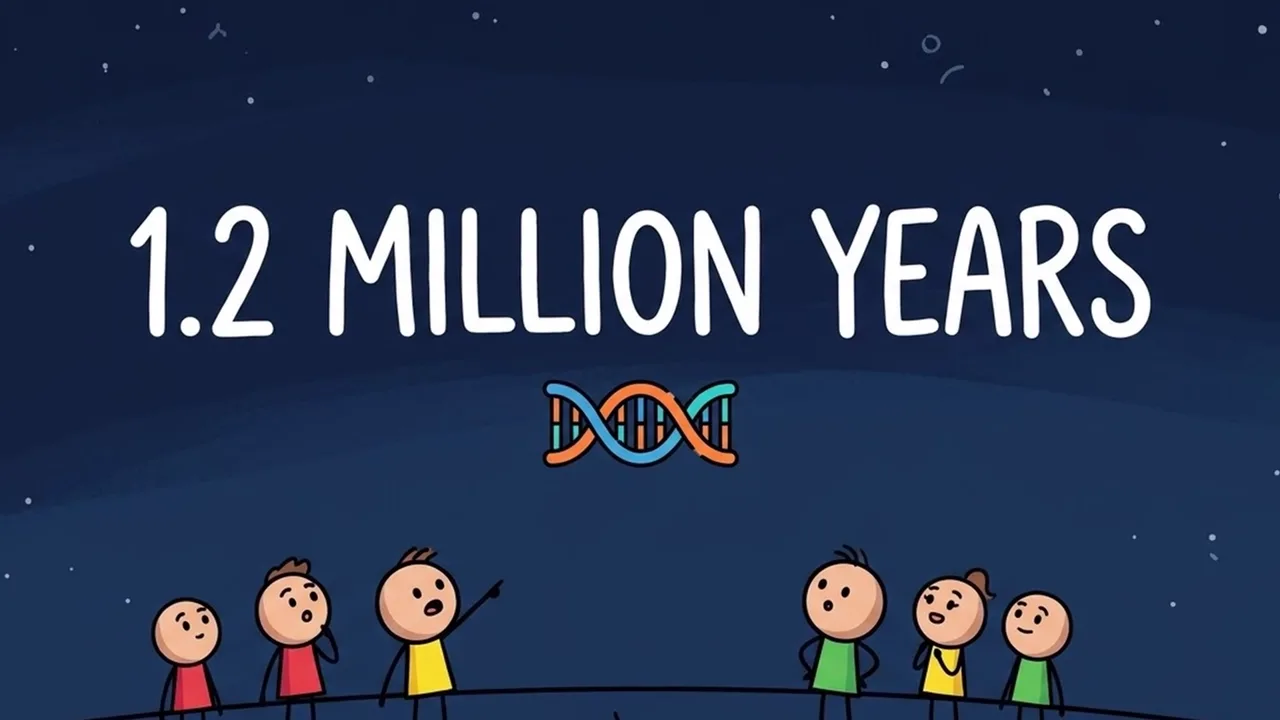
| 11 | A gene linked to dark skin suggests the change happened as far back as 1.2 million years ago. Say "about 1.2 million years ago, a minimum age for hair loss". | R | A selective sweep at MC1R ("as many as 1.2 million years ago"). This is an indirect, minimum estimate of when hair was lost; later commentary says MC1R timing does not settle when hair was lost. UF press piece says only "about 1 million years ago". Original says "as far back as", which is fair, but "we lost our fur 1.2 million years ago" would overstate. | Rogers, Iltis, Wooding, "Genetic variation at the MC1R locus and the time since loss of human body hair", Current Anthropology 45(1):105-124, 2004. https://www.journals.uchicago.edu/doi/10.1086/381006 |
| 12 | "For roughly a million years our ancestors walked around with almost no fur and very likely no clothes." | R | Follows from #11 (1.2 Mya) against #8 (83-170 ka) and #19 (90-120 ka). It is inference from two estimates, not measured. Say "probably". | Derived from Rogers et al. 2004 and Toups et al. 2011 / Hallett et al. 2021. |
| 13 | Humans have far more sweat glands than chimpanzees, and sweating cools us in heat. Safer: "far more than other apes". | R | Eccrine gland density is on average 10-fold higher in humans than in chimpanzees and macaques. Not shown for "almost any other mammal" (horses, for example, sweat heavily). | Kamberov et al., "Comparative evidence for the independent evolution of hair and sweat gland traits in primates", Journal of Human Evolution, 2018. https://pmc.ncbi.nlm.nih.gov/articles/PMC6289065 ; Penn Medicine, 2021 https://pennmedicine.org/news/news-releases/2021/april/the-chillest-ape-how-humans-evolved-a-super-high-cooling-capacity |
| 14 | Hairlessness plus sweating lets humans shed heat and keep going in midday heat; ancestors may have kept tracking prey while furred animals rested. Narrate as "may have". | R | Lieberman and Bramble: humans can run long distances in hot, arid conditions, rare among mammals. The persistence-hunting link is a hypothesis, not proven. | Bramble and Lieberman, "Endurance running and the evolution of Homo", Nature, 2004. https://www.nature.com/news/2004/041115/full/news041115-9.html ; Harvard Gazette, 2007 https://news.harvard.edu/gazette/story/2007/04/humans-hot-sweaty-natural-born-runners/ |
| 15 | Bare skin that cools at noon also loses heat at night, which became a problem in cold climates and ice ages. | R | Standard reasoning in the hair-loss literature, no single measured figure. Say "so cold became a problem". | Jablonski 2004 (#9); Gilligan, Aeon essay https://aeon.co/essays/how-clothing-and-climate-change-kickstarted-agriculture |
| 16 | Clothing is removable, so it is more flexible than fur. | C (logic, not data) | Not a measurable claim. Fine as plain reasoning. | n/a |
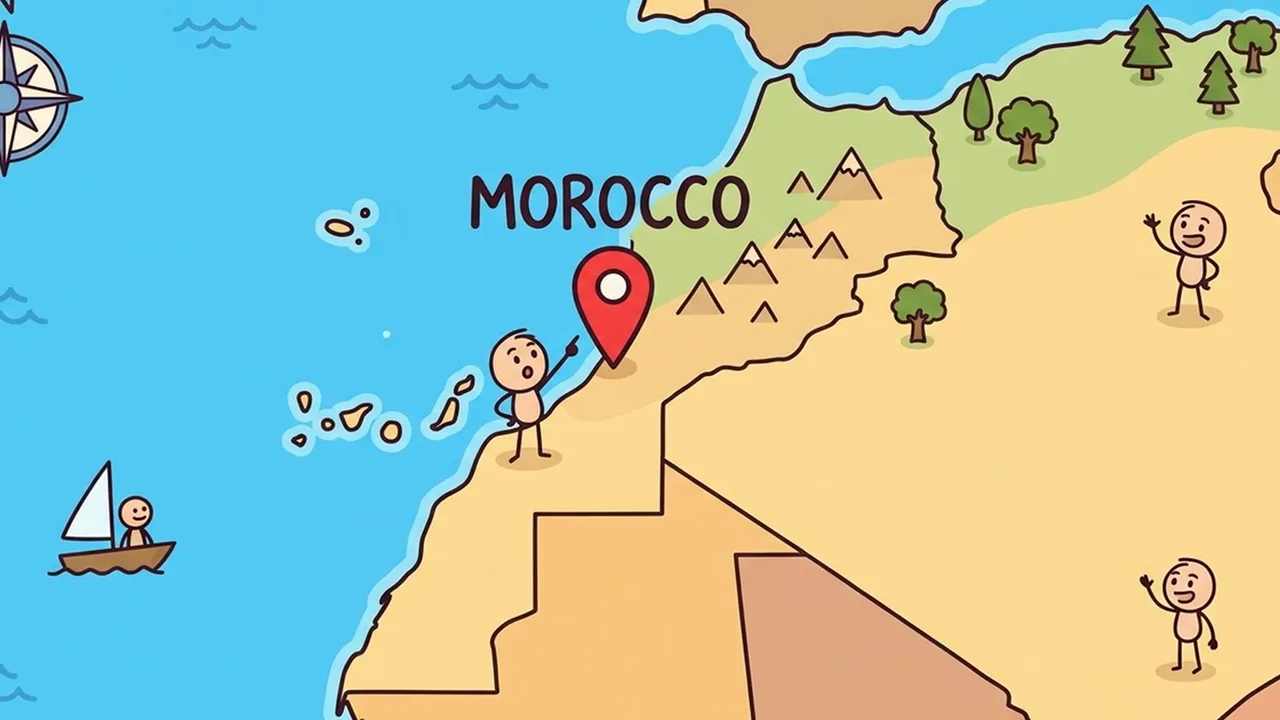
| 17 | Contrebandiers Cave is on Morocco's Atlantic coast. Bone tools dated to about 90,000-120,000 years ago. | C | "120,000-90,000 years ago". OSL ages: oldest tools 116.1 +/- 2.9 ka, youngest 95.9 +/- 4.1 ka. | Hallett et al., iScience 24(9):102988, 2021. https://pmc.ncbi.nlm.nih.gov/articles/PMC8478944 |
| 18 | "Dozens of bone tools." | C | 62 Middle Stone Age worked bone tools (7 are spatulates, all from Layer IV-2). | Same as #17. |
| 19 | The wear on some tools matches scraping hides and making leather. Say "looks like", "probably". | R | Spatulates interpreted as leather-working tools from use-wear at 40x; residue analysis was not possible; contact material not directly confirmed. | Same as #17. |
| 20 | Cut marks on sand fox, golden jackal and wildcat bones fit skinning for fur, not butchering for meat. | C | Sand fox: 12 specimens (9% of MSA sand fox remains). Golden jackal: 2 (7%). Wildcat: 2 (8%). Authors call pattern "consistent with modern fur removal". | Same as #17. |
| 21 | This is a "workshop" for hides and fur, "highly suggestive" of the earliest clothing but not clothes themselves. Do not say "proof of clothing". | C | Authors: "highly suggestive proxy" for the earliest clothing. | Same as #17. |
| 22 | The cave is called "Contrebandiers" (French for "smugglers"). The original's "Contre Bandier's" spelling is wrong. | C | Name: Grotte des Contrebandiers. | Hallett et al. 2021 (#17). |
| 23 | Neanderthals used animal skins. Some researchers think their clothing was simple, like a cape draped on the shoulders. Debated. | R | Collard et al. 2016: leporid, canid and mustelid remains are more frequent in early modern human layers than in Neanderthal layers; authors conclude Neanderthals "likely employed only cape-like clothing". Gilligan argues Neanderthals lacked tailored clothing, but also says "we don't need to have eyed needles to manufacture clothing". Counter-proposals: birch-bark glue (Baker et al. 2021) and wooden needles. | Collard et al., "Faunal evidence for a difference in clothing use between Neanderthals and early modern humans in Europe", Journal of Archaeological Science, 2016. https://abdn.elsevierpure.com/en/publications/faunal-evidence-for-a-difference-in-clothing-use-between-neandert/ ; Gilligan, ANU portal https://researchportalplus.anu.edu.au/en/publications/neanderthal-extinction-and-modern-human-behaviour-the-role-of-cli/ |
| 24 | Modern humans then had small bone needles with an eye, letting them sew fitted clothing. | R | Eyed needles have been recovered only from sites linked to Homo sapiens (Denisova needle's maker is uncertain). Gilligan: awls (no eye) appear in Africa about 80,000 years ago; eyed needles about 40,000 years ago in Siberia. | Gilligan et al. summaries: Cosmos https://cosmosmagazine.com/history/archaeology/eyed-needles-fashion-clothing ; ZME https://zmescience.com/science/news-science/eyed-needle-fashion-early-humans . Underlying journal paper not opened. |
| 25 | Oldest known eyed needle: about 50,000 years old, a bird-bone needle from Denisova Cave, Siberia, found 2016. Its maker may be Denisovan or Homo sapiens. | R | "50,000 years old" per excavator Mikhail Shunkov. A cave-chronology paper lists Denisova eyed needles at 41.9-36 ka cal BP, so the exact age is contested. Sibudu (61,000 years) is a bone point, only possibly a needle, and has no confirmed eye. | Archaeology magazine, "Denisova Cave Yields a 50,000-Year-Old Needle", 2016. https://archaeology.org/news/2016/08/23/160823-denisova-cave-needle/ ; Propylaeum eyed-needle chapter https://books.ub.uni-heidelberg.de/propylaeum/catalog/view/1678/2865/131813 |
| 26 | The original says oldest needles are "roughly 40 to 50,000 years old". Acceptable as a range. Safer: "around 40,000 to 50,000 years". | R | 50,000 (Denisova, excavator) and about 40,000 (Gilligan, eyed needles). Original's range matches the spread. | #24, #25. |
| 27 | Some scientists think tailored clothes gave modern humans an edge in the coldest times. It is debated, and Neanderthals vanished for many reasons. | R | Gilligan: cold adaptations delayed Neanderthal clothing technology and contributed to extinction; opposing views exist. Treat as a hypothesis. | Gilligan, ANU portal (#23). |
| 28 | Ötzi died about 5,300 years ago in the Alps, and was found by hikers in 1991. | C | Found 19 September 1991 by hikers Erika and Helmut Simon at about 3,210 m. Age about 5,300 years (c. 3350-3105 BC range). | The Discovery, South Tyrol Museum of Archaeology. https://www.iceman.it/en/the-discovery/ ; Ötzi, Wikipedia https://en.wikipedia.org/wiki/%C3%96tzi |
| 29 | Ötzi wore a bearskin cap, a coat of goat and sheep hide strips, and shoes stuffed with grass. | C | Bearskin cap with chin strap. Coat from light and dark strips of goat and sheep hide, sewn with sinew, almost knee-length. Shoes: inner net of linden bark with dry grass padding, deerskin upper, bear-hide sole per museum shoe section (page text gave "leather sole"; verify "bearskin sole" before narrating). | Clothing, South Tyrol Museum of Archaeology. https://www.iceman.it/en/oetzi/clothing |
| 30 | A grass cape/coat: the old "grass cape" is now thought to be a mat or backpack part. Do not call it clothing. | C | Museum: "more likely a rain mat or part of a backpack". | Same as #29. |
| 31 | By Ötzi's time clothing was a full technology (sewn, repaired, layered, several animal sources). | C | A 2016 DNA study found the coat came from at least 3 goats and 1 sheep, apparently patched over time. | Smithsonian summary of Scientific Reports 2016 study. https://www.smithsonianmag.com/smart-news/dna-analysis-reveals-what-otzi-iceman-wore-his-grave-180960170/ |
| 32 | Clothing carries social meaning (group, rank). Say "ornaments such as shell beads show people marked identity long before Ötzi". Original's "shells sewn onto a cape", "a color that took days to make", "a fur only some could wear" are unsourced and come across as general, not tied to a find. | R | Perforated shell beads at Bizmoune Cave, Morocco: at least 142,000 years ago (33 beads), "identity markers" per authors; beads possibly worn as jewellery or clothing decoration. Gilligan: decoration became a social function of clothing once cold climates required constant covering. | Sehasseh et al., "Early Middle Stone Age personal ornaments from Bizmoune Cave, Essaouira, Morocco", Science Advances, 2021. https://pmc.ncbi.nlm.nih.gov/articles/PMC8457661 |
| 33 | Rules about what must be covered vary by culture and period; shame about nakedness is learned. | R | Developmental sources: self-conscious emotions appear around 15-24 months, and the situations that trigger them are taught by culture. None directly measures nudity shame. | Child Growth and Development (eCampusOntario), emotional development chapter. https://ecampusontario.pressbooks.pub/childgrowthanddevelopment/chapter/7-emotional-development-in-infancy-and-toddlerhood/ . Weak, secondary source. |
| 34 | "Toddlers don't have it. Watch any two-year-old escape from the bath." | X | Contradicted in part: self-awareness and embarrassment start around 15-24 months, and shame becomes acute around age 3. No study found on toddlers lacking nudity shame specifically. Also, the original says "two-year-old" while this is an anecdote. | Same as #33; also https://tutorchase.com/answers/a-level/psychology/at-what-age-do-children-develop-self-conscious-emotions . |
| 35 | "The feeling of being seen naked comes from ancient clothing" or "burning face" as innate. | X | Nothing found that supports an evolutionary origin of nudity shame. The original only says it is learned, which fits #33. Present as a question, not a fact. | No source. |
## Count
- C = 18: rows 1, 3, 4, 5, 6, 8, 9, 10, 16, 17, 18, 20, 21, 22, 28, 29, 30, 31
- R = 14: rows 7, 11, 12, 13, 14, 15, 19, 23, 24, 25, 26, 27, 32, 33
- X = 3: rows 2, 34, 35
- Total 35.
## Where the original rounds or overstates
- Row 7: "In 2003 ... about 107,000 years". The paper's own range is about 32,000-112,000 years (clade about 72,000). 107,000 is from a press release.
- Row 8: the study is dated 2010 online / 2011 in print. The range is correct. Do not shorten to "170,000".
- Row 11: 1.2 million years is an upper age for the gene change, not a fur-loss date.
- Row 13: "more than almost any other mammal" is not sourced. The source compares humans to chimps and macaques (10 times).
- Row 22: "Contre Bandier's" should be Contrebandiers.
- Row 25: "oldest known needle" is about 50,000 years per the excavator only. Chronology papers give about 40,000.
- Row 32: shells on a cape, days-long dyes, restricted furs are not tied to any cited find.
- Row 34: "toddlers don't have it" is not supported.
## Do not say
1. "No other animal gets dressed" as a flat fact (row 2). Use "no other animal makes clothes".
2. "Clothes began 170,000 years ago" or "107,000 years ago" as a single number (rows 7, 8). Always give the range.
3. "We lost our fur 1.2 million years ago" (row 11). Say "may be as old as 1.2 million years".
4. "Humans sweat more than almost any other mammal" (row 13). Say "far more than other apes".
5. "Proof of the first clothes" at Contrebandiers Cave (row 21). Say "tools and bones that point to making clothing".
6. "Neanderthals only wore capes" (row 23). It is a debated idea.
7. "The needle won the Ice Age" or "needles caused Neanderthal extinction" (row 27).
8. "Oldest needle is exactly 50,000 years" and the Sibudu 61,000 needle (row 25). Say "about 40,000 to 50,000 years".
9. Ötzi's "grass coat or cape" (row 30). Museum says mat or backpack part. Check the "bearskin soles" wording against the museum shoe page before using it (row 29).
10. "Toddlers feel no shame about nakedness" and any claim that nudity shame is innate (rows 34, 35).
11. Shells sewn on capes, days-long dyes, restricted furs as facts (row 32), unless a specific find is cited.
12. "Contre Bandier's cave". Write "Contrebandiers Cave" or just "Smugglers' Cave".